
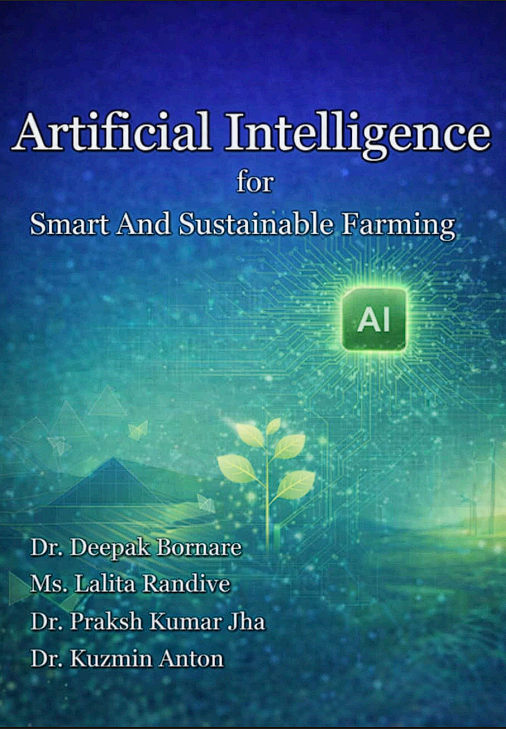
Artificial Intelligence for Smart and Sustainable Farming
Dr.Deepak Bornare, Ms. Lalita Randive, Dr. Prakash Kumar Jha, Dr.Anton Kuzmin
FORMAT
Paperback and e–book
ISBN
978-93-49359-05-5
PAGES
147 pages
PRICE
Rs. 1000/- ($80)

About The Editors

Dr. Deepak Bornare is an academician and researcher in Agricultural Engineering with over two decades of experience in teaching, research, and applied consultancy. He serves as Associate Professor and Head, Department of Agricultural Engineering, at MIT (Autonomous), Chhatrapati Sambhajinagar, Maharashtra, India, and holds additional roles as Deputy Director, MIT-CARS, and Director, MITARDC.He earned his Ph.D. from IIT Bombay, with postdoctoral research exposure at Ben-Gurion University of the Negev, Israel, and is pursuing a Post-Graduate Certificate in Drone Technology from IIT Ropar under the AICTE-QIP Fellowship. His research focuses on precision and climatesmart agriculture, AI-driven crop nutrient diagnostics, dronebased agritech systems, soil health and biochar technologies, and sustainable water and environmental management.Dr. Bornare has published in Scopus-indexed journals, books, and book chapters, holds patents in AI-enabled agricultural diagnostics, and actively contributes to professional bodies, curriculum development, and policy-oriented academic initiatives, with a commitment to interdisciplinary research and education.

Ms. Lalita Randive is an Assistant Professor in the Department of Computer Science and Engineering at MIT, Aurangabad, with over a decade of teaching experience in computing and engineering education. She holds an M.E. in Computer Science and Engineering with distinction and is pursuing a Ph.D. in Computer Engineering at Dr. Babasaheb Ambedkar Marathwada University, Aurangabad. Her academic interests include digital image processing, data science, artificial neural networks, and artificial intelligence, with applications to crop nutrition deficiency detection and intelligent systems

Dr. Prakash Kumar Jha is Director of the Mississippi Agroclimatology Collaboratory in the Department of Plant and Soil Sciences at Mississippi State University. His work integrates climate science, crop ecophysiology, machine learning, and digital agriculture to support climate-resilient, sustainable farming systems. He leads projects in soil moisture modeling, crop simulation, evapotranspiration, and remote sensing–based decision support. He received his PhD in Crop and Soil Sciences from Michigan State University, MS from the Indian Agricultural Research Institute, and BSc (Agriculture) from Banaras Hindu University. He has extensive publications and international recognition in agronomy, climate impacts, and precision agriculture.

Dr.Anton Kuzmin holds a PhD in Engineering and the academic title of Associate Professor. He is an Associate Professor in the Department of Mechanization of Agricultural Products Processing at National Research Mordovia State University, Saransk, Russia. He is also affiliated with the Scientific Laboratory of Advanced Composite Materials and Technologies at Plekhanov Russian University of Economics, Moscow, Russia, where he contributes to research-led teaching and supervision in materials science. His academic work focuses on polymer and wood-polymer composites, biodegradable materials, and the mechanical performance of advanced composite systems. He actively serves as a reviewer and editorial contributor for scientific journals in agricultural engineering and materials science.
About The Book
Artificial Intelligence for Smart and Sustainable Farming presents a comprehensive exploration of how
AI-driven technologies are revolutionizing agricultural systems worldwide. The book covers a wide range
of topics including machine learning applications in crop yield prediction, smart irrigation systems,
remote sensing, drone-based monitoring, robotics, decision support systems, and sustainable farm
management practices.
By combining technological innovation with sustainability principles, the book emphasizes efficient
resource utilization, reduced environmental impact, and enhanced agricultural productivity. Case studies,
conceptual frameworks, and future research directions provide readers with a holistic understanding of
emerging trends and challenges.
This book serves as a valuable reference for students, researchers, and professionals seeking to
understand and apply artificial intelligence in agriculture, while contributing to global goals of food
security, environmental sustainability, and rural development.
Other Books

ISBN : 978-81-930928-1-1

ISBN : 978-81-930928-3-5

ISBN : 978-81-930928-2-8