
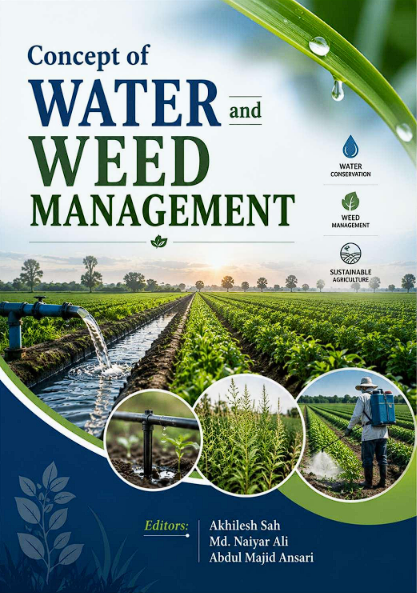
Concept of Water and Weed Management
Dr. Akhilesh Sah, Dr. Md. Naiyar Ali and Dr. Abdul Majid Ansari
FORMAT
Paperback and e–book
ISBN
978-93-49359-30-7
DOI
doi.org/10.5281/zenodo.22721082
PAGES
228 pages
PRICE
Rs. 1000/- ($80)

About The Authors

Dr. Akhilesh Sah has completed B.Sc. (Ag.) in 1998 and M.Sc. (Ag.) in 2001 from Birsa Agricultural University (BAU), Ranchi. He has appointed as Junior Scientist-cum-Assistant Professor at BAU in 2004. He awarded PhD degree in Agronomy (Gold Medallist) from BAU, Sabour, Bhagalpur, Bihar in 2017. He has actively engaged in agronomical research cereal cops. He is life member of four professional societies and member of editorial advisory board of three national & international Journals. He is also reviewer of various national/international journals. He has published more than 27 research papers in reputed journals, two short communication, three books and two book chapters, seven popular article and more than 39 abstracts in national and seven in international conferences. He delivered four invited lectures and presented eight research papers (oral/poster) in different seminars, symposiums and conferences. He has actively participated in transfer of technology activities like delivering lectures for officers/extension personnel who engaged in extension and development of agriculture, TV talk, Radio talk, Krishak Gosthi, Kisan Mela etc. for the farmers.

Dr. Md. Naiyar Ali has completed B.Sc. (Ag.) in 1998 and M.Sc. (Ag.) in 2001 from Birsa Agricultural University (BAU), Ranchi. He has appointed as Junior Scientist-cum-Assistant Professor at BAU in 2004. He awarded PhD degree in Agronomy from GBPUA&T, Pantnagar in 2012. He has supervised for six MSc students thesis research as major advisor. He has actively engaged in agronomical research cereal cops. He is life member of six professional societies and member of editorial advisory board of three national & international Journals. He is also reviewer of various national/international journals. He has published more than 38 research papers in reputed journals, two short communication, seven popular article and more than 45 abstracts in national and seven in international conferences. He delivered four invited lectures and presented 10 research papers (oral/poster) in different seminars, symposiums and conferences. He has felicitated by various professional societies. He has actively participated in transfer of technology activities like delivering lectures for officers/extension personnel who engaged in extension and development of agriculture, TV talk, Radio talk, Krishak Gosthi, Kisan Mela etc. for the farmers.
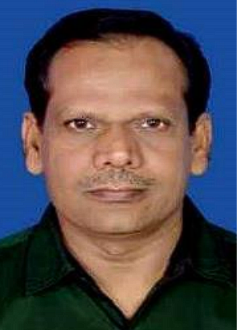
Dr. Abdul Majid Ansari Ph.D., devoted his academic career to Agriculture, particularly in the field of Horticulture as a Research and Extension worker. Dr. Ansarihas been working as a Junior Scientist-cum-Assistant Professor (Horticulture) at ZRS, Chianki, Birsa Agricultural University, Ranchi. Dr. Ansari did his Doctorate in Vegetable Science (2012) from G.B. Pant University of Agri & Tech., Pantnagar. He has contributed significantly in the field of vegetable breeding and developed a large number of advance lines of eggplant, tomato and vegetable peas. He has been maintaining alarge number of germplasms of different vegetableand fruit crops at the station. He has also made a vibrant link with farmers by advising them to promote scientific management of horticultural crops. He 36 research papers, three review articles, 24 oral/poster presentation, three lead papers presentation, five books, four book chapters, 12 popular articles, four leaflet/folder, reviewed several research papers of three international journals viz., Scientia Horticulturae, Fruits Journal and AgronomyJournal and delivered 74 lectures in the different seminar/symposia/conference/workshop.He has a life membership of 10 scientific societies. He is working as a member of editorial board in the 8 National/International Journal of Agricultural and Allied Sciences and participated in the 9 refresher courses of horticultural importance.
About The Book
Water and weeds are two major factors that significantly influence crop growth, productivity, and profitability. Efficient management of water is essential for maintaining optimum soil moisture, ensuring proper crop growth, and improving water-use efficiency. Similarly, effective weed management is necessary to minimize competition between crops and weeds for water, nutrients, light, and space. Agriculture is facing increasing challenges due to irregular rainfall, declining water resources, climate variability, and the growing demand for food. Under such conditions, efficient water management practices such as proper irrigation scheduling, suitable methods of irrigation, rainwater harvesting, mulching, drainage management, and conservation of soil moisture can help improve crop productivity and reduce wastage of water. The adoption of modern techniques such as drip and sprinkler irrigation and precision water management can further enhance water-use efficiency. Weeds are among the most important biological constraints to crop production. They emerge rapidly, compete with crops for essential resources, and may reduce crop yield and quality considerably. Effective weed management requires proper identification of weeds, knowledge of their biology and ecology, and an understanding of the critical period of crop– weed competition. Cultural, mechanical, biological, and chemical methods of weed control, when used appropriately and in an integrated manner, can provide effective and economical weed management. This material on Concept of Water and Weed Management has been prepared to provide students and agricultural professionals with a basic understanding of the principles, practices, and technologies involved in efficient water utilization and effective weed control. Emphasis has been given to practical, economical, and environmentally sustainable approaches. It is hoped that this material will be useful for academic learning as well as for understanding the practical aspects of crop production under diverse agricultural conditions.
Other Books

ISBN : 978-81-930928-1-1

ISBN : 978-81-930928-3-5

ISBN : 978-81-930928-2-8